
Epistemologies of Knowledge
This week we will explore the conflict between two different epistemologies of knowledge. The first based upon the traditional view of knowledge as content in the form of subjects or learning areas, and the second and more progressive view that knowledge is active and ‘resolves challenges’ through problem based learning and just-in-time knowledge acquisition.
The study of epistemology focuses on the way we acquire knowledge and how we can differentiate between fact and fiction. Modern epistemology generally involves a debate between rationalism and empiricism.
The Purpose of Education
On this week's session we are challenging you to think what is the purpose of education. Why do you do what you do? And why is there suddenly such a huge focus on education transformation? What is driving the evolution?
Practising Teacher Criteria
4.ii. participate responsively in professional learning opportunities within the learning community
Whakataukī
Naku te rourou nau te rourou ka ora ai te iwi
With your basket and my basket the people will live
A need to update delivery methodologies and enhance existing pedagogies lies at the heart of digital and collaborative learning?
There is broad acceptance that today’s students are changing far more rapidly than the schools who teach them. Their familiar means of information aggregation and distribution are not in sync with the education system and students are looking for flexible, more affordable and more relevant ways to gain the knowledge needed to apply ‘as needed’ skills for life-long learning.
Our great-grandparents would see our lifestyle as bizarre – “electronic nomads wandering among virtual campfires” – yet in counterpoint many youth today see prior generations as hapless prisoners of geography, trapped in the limits of a single physical location. (Mitchell, 2003)
For generations we have pursued a "knowledge-based" curriculum that was developed at a time when access to information was scarce. Today’s digitally connected world offers unlimited, immediate and accurate information to nearly all the world’s questions. As answers to questions we already know provide little, if any, competitive advantage in today’s world it can be argued that education should now focus on stimulating and promoting the discovery of new possibilities.
It was only a generation ago that computers had limited processing functionality and they operated on the level of a modest calculator. With the advent of powerful computers with the ability to operate multiple tasks simultaneously the need to reevaluate the most effective way to use technology as a significant educational enabler has never been more important.
A timely, pioneering and courageous approach to learning would address the need to develop students who are "learners" rather than setting out to achieve the end goal of making sure they are "learned”. Learners need to be involved in inquiry based learning process presenting content that seeds and stimulates interaction and the development of new concepts and skills. The development of a close community of fellow ‘learners’ to organically facilitate partnerships and teamwork in the learning experience provides further benefit through the exposure to different student perspectives and experiences. While the building blocks that form the skills to think, act, respond, investigate, evaluate and action are core to all education paths and careers, few of these skills are utilised in existing online learning experiences.
While technical advances in hardware, software and connectivity have been the catalyst to the progress of modern education, commitment to key competencies are imperative to meaningful learning outcomes. In this aspect two key features of constructivist philosophy have the potential to change the education offering. These features are play (fun) and experimentation (the ability to fail and fix fast).
People across the world are ‘hacking education’ and fighting for de-schooling or the process of replacing formal schools with the technologically enabled, largely self-directed, free and open exchange of information.
An under-current of change driven by new teaching practices with proven success includes greater focus on functional skills, collaboration, creativity, understanding and evaluation of online data, social and cultural awareness, global connectedness and effective communication. The most progressive schools and institutes are gradually accepting the transition from teacher to student centred in the classroom. This shift has seen acceptance of the sharing of learning outcomes and a move from ‘covering the curriculum’ to ‘discovering’ it.
The major challenge for schools is ensuring that all students attain the skills, knowledge and the disposition they will need to be successful in the world that awaits them. The new economy demands that all students be prepared for work and for citizenry and that they all attain the high standards of achievement that have traditionally been reserved for a select few. This generation of students will need to graduate from high school with the ability to think and reason, a comfort with complex cognitive demands, a readiness to be flexible and adaptive, and a command of print, visual, quantitative and digital literacy. Technology is increasingly becoming seamless and invisible as improved technology resourcing and ‘bring your own device’ is becomes more commonplace in the classroom as the tools of modern education.
Physical learning environments are also changing and it is becoming increasingly common to see creative teaching spaces that support different learning styles and teaching needs. In addition, mobile learning (equally referencing learning on- the-move and in varied locations as from a mobile device) has become a core focus of student engagement. The advent of wireless and pervasive technologies offers many opportunities for designing learning experiences that encourage children to explore, initiate and reflect.
In many cases schools have used new technology to enhance old models of learning rather than using technology to transform the way teaching is designed and delivered. The need to update delivery methodologies and enhance existing pedagogies lies at the heart of digital and collaborative learning.
Developing Essential Digital and Innovation Skills for 21st Century Education Delivery
Education is being challenged by the impact of new technologies and unlimited online access to user driven content.Today’s student is increasingly in conflict with the traditional analogue education system and education delivery practices.
While the adoption of technological practice is core to the unprecedented transformation that is taking place, the shift has been further compounded by the need to prepare our students for careers that don’t yet exist. Educators have found themselves in needing new skills and knowledge that blends digital connectivity and collaboration with the converging world of learning innovation, digital pedagogy, online education and global networks.
‘The fact is that given the challenges we face, education doesn’t need to be reformed- it needs to be transformed. The key to this transformation is not to standardise education, but to personalize it, to build achievement on discovering the individual talents of each child, to put students in an environment where they want to learn and where they can naturally discover their true passions” (Robinson, 2009)
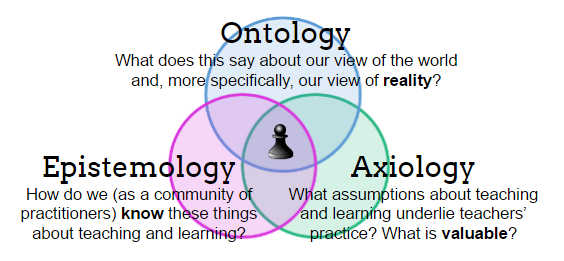
Ontology, Axiology and Epistemology
Ontology, axiology and epistemology are important related concepts in philosophy.
Ontology originally referred to the branch of metaphysics dealing with the nature of being and reality. In short, ontology refers to our ideas of reality and how it is constituted.
Epistemology, in turn, is interested in how we can acquire knowledge about that reality. The Greek word, ‘episteme’, refers to knowledge. Epistemologists try to identify the essential, defining components of knowledge. Thus, both of these provide a basis for learning and teaching, and they appear in learning theories. Equally, what we understand by learning and teaching leads to ontological and epistemological assumptions.
In addition to ontology and epistemology, there is a third concept of axiology that relates to value theories. It considers the values related to both ontology and epistemology. In its broad sense in the context of ontology, it addresses questions such as what is considered valuable in our world and our existence in it.
Further, in the context of epistemology, it addresses the question of what is valuable knowledge in that world and what means are valued in order to gain that knowledge. Education is society’s media for manifesting its ideas. The ideas educational systems adopt reflect what society regards as valuable for its success and welfare.
Source: Audi, R. (gen. ed.) (1995), The Cambridge Dictionary of Philosophy, Cambridge: Cambridge University Press.
Philosophy of Education
If you want, you can read http://plato.stanford.edu/entries/education-philosophy/ and reflect on your own teaching practice and personal views on the Philosophy of Education and Knowledge.
Purpose of Education
Gert Biesta helps us to a wider view of education by focusing on the question of purpose – putting the ‘why’ of education before the ‘how’. He suggests these three broad domains of educational purpose:

Why reflect on a blog?
Experience alone does not add value to life, or your practice. It’s not necessarily the experience that is valuable; it’s the insight you get because of your experience. Reflective thinking turns experience into insights!
Source: Maxwell, J. C. (2009). How successful people think: Change your thinking, change your life. Hachette UK.
I can see a day in the not too distant future (if it’s not already here) where your “digital footprint” will carry far more weight than anything you might include in a resume or CV.
Source: Betcher, C. (2009). Digital footprints. Retrieved from http://chrisbetcher.com/tag/digitalfoot print/
If you need help setting up your optional reflective blog
- Ask help from your peers or even students?
- Start small
- Your Blog can be a Private or Public one
- Remember that you can choose any platform
- Blogger might be easiest (linked to your Google account)
- Wordpress, Weebly and Wix have been used a lot too
- It can be even just (for example a Google Site, OneNote) notes about your reflections
At next week’s session (first 15 minutes) we’ll help each other to set up blogs if needed. We'll also talk about the Assessments on next week's session. You’ll get all the information then. The first Assessment will be a video. So check what video editing tools and programmes you have on your devices and learn to use them. We’ll be making videos during the upcoming weeks, so use that time to upskill together.
The traditional view of knowledge is as 'content' in the form of subjects or learning areas. That students come out 'learned' instead of 'learners'.Gert Biesta talks about domains in gaining knowledge through a more progressive view that knowledge is active and resolves challenges through problem based learning and just in time learning. He suggests 3 broad domains of education purpose.
Knowledge and the purpose of education are intertwined. The task of education is to "fuel the desire to want to exist in the world in a grown up way" "Being at home in the world"
In my classroom the purpose of education is visible through my focus on transferring skills across the curriculum. Placing a high value on values based learning integrated into inquiry learning. Encouraging accountability and responsibility. Strong focus on the development of early literacy and numeracy skills.
I need to consider several areas as I reflect on the purpose of education and how I share this understanding with the wider community. Mainly that I ensure I am not just covering the curriculum but allowing the children to discover it, and that their digital literacy gets a chance to grow with more meaning and purpose - reaching the wider community. Also that students become more reflective about their learning and more curious about the world.

No comments:
Post a Comment