
This week we will look at what should the overall goal of education be, with a focus on building Adaptive Competence.
We will explore pedagogically sound ways of Implementing technological change in the classroom with a view to developing adaptive competence in our learners.
Educators need a model to assist with their understanding of how to design, develop, and infuse digital learning experiences that utilize technology. We will explore the SAMR model and Technological Pedagogical Content Knowledge (TPACK), which is a framework to understand and describe the kinds of knowledge needed by a teacher for effective pedagogical practice in a technology enhanced learning environment.
Whakataukī
Ka mate te kāinga tahi, ka ora te kāinga rua.
There is more than one way to achieve an objective.
There is more than one way to achieve an objective.
Practising Teacher Criteria
12.i. systematically and critically engage with evidence and professional literature to reflect on and refine practice
Adaptive Competence
Adaptive competence fits with workers in the knowledge economy who are able to innovate to meet necessary outcomes. Artists (generative competence) are not necessarily working to outcomes or a client's brief but it is easier to move from delivered competence to adaptive competence if we have some creativity. This is why art is more important than ever, since to make this move we need to have creative thinkers who are able to adapt. At the moment, many educational settings still sit at the delivered competence level.

You can find some more detail at Adaptive Competence - The dominant space for human action in the age of knowledge-work
Modelling Innovation
Two simple models, used by many teachers, can help us to plan and analyse our digital classroom innovations. Substitution Augmentation Modification Redefinition (SAMR) supports the design and development of learning experiences that utilize technology. Technological Pedagogical Content Knowledge (TPACK) attempts to identify the nature of knowledge required by teachers for technology integration in their teaching.
SAMR
The SAMR model was developed by Ruben Puentedura and disseminated through Apple education initiatives. It is a very simple layered model of ways that technology can be integrated into teaching and learning. For further information see Puentedura's Weblog and the TKI page on Using the SAMR model. Mark Anderson provides a very similar 4 layer model that focuses more on teacher confidence in delivering digital learning

TPACK
Technological Pedagogical Content Knowledge. TPACK is a framework developed by Punya Mishra and Matthew Koehler that identifies the knowledge teachers need to teach effectively with technology.The TPACK framework is somewhat more academic that SAMR and extends Shulman’s idea of Pedagogical Content Knowledge.

For further information see the tpack.org web site
You may find this TPACK and SAMR assessment rubric useful when assessing classroom activities against these frameworks.
Google Maps and Google Earth group task
Create a Google Doc where you design a learning activity to last 20 minutes using either Google Earth / Maps or Tour Builder and informed by SAMR and/or TPACK. Make sure that your group members can edit the document and anyone ‘Can comment’ on your document. Once done, link your learning activity document onto the Google+ community (session uploads) and ask others to critique it.
If you want, you can look at Thom Cochrane’s guide to creating a custom map http://tinyurl.com/tmlmaphowto or consider tour builder https://tourbuilder.
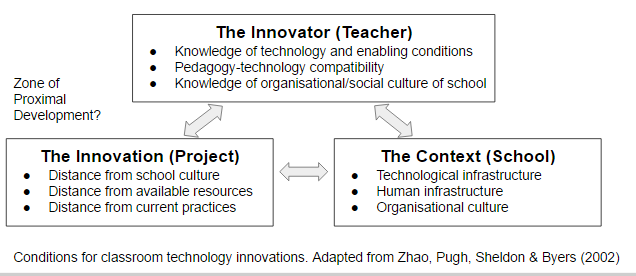
Conditions for Classroom Technology Innovations
To what extent do you think the homework reading, a research article from 2002, is still relevant?
Creativity and Innovation
According to Tucker (2008), there is a relationship between being creative and innovative. Creativity helps coming up with ideas and being innovative means bringing them to life. Hatching ideas is the ‘creative’ part; bringing them to life successfully in the form of a new product or service or management method is what makes a raw idea an innovation.
Warlow (2007) defines the following attributes of an innovator:
- Curious; constantly questioning things
- Open to new ideas; putting oneself in situations where one can receive stimulation
- Dare to be different; being prepared to act against accepted or conventional wisdom and challenge the unchallengeable
- Be ready; as innovative ideas can strike at any time, there is a need to capture them before they disappear from the mind
- Persistent; time is needed in finding the solutions which are innovative
- Collaborative; ideas can be thought of when working with others
The World Economic Forum (2016) in analysing 21st century skills, identified creativity and collaboration as competences, but curiosity is a character quality, as is initiative. To be innovative, we need not only competencies but also character qualities.
References
Tucker, R. B. (2008). Driving growth through innovation. San Francisco: Berrett-Koehler.
Warlow, R. (2007). Being an innovative entrepreneur. Retrieved April 2, 2010 from http://ezinearticles.com/?Being-an-InnovativeEntre...
World Economic Forum. (2016). New Vision for Education: Fostering Social and Emotional Learning through Technology. Retrieved fromhttp://www3.weforum.org/docs/WEF_New_Vision_for_Education.pdf

No comments:
Post a Comment