
As education evolves, education is working hard to keep up fostering teaching that supports an interdisciplinary approach to problem solving.
Design Thinking is a hands-on problem finding and solving session that provides a forum for experiential learning. We apply Design Thinking methods such as posing short explorative questions that launch brainstorms. This builds a platform broad enough to uncover a wide range of solutions. We then learn to shape options that are sufficiently narrow to work through the problems using rapid prototyping techniques.
As a result, we are able to flesh out a number of needs that are both meaningful and actionable. Like designers, we will create simple three-dimensional models to get our ideas across.
Whakataukī
E kore te pātiki e hoki ki tōna puehu
The flounder (fish) does not return to his dust (Don’t make the same mistake twice!)
The flounder (fish) does not return to his dust (Don’t make the same mistake twice!)
Design Thinking in Leadership
Design Thinking argues very convincingly that we would need to provide more time for the discovery, interpretation, ideation, experimentation and evolution of ideas, both for students and for teachers.
Instead of looking at what assets a company has to create a product, leaders who use design thinking first ask what their clients require and then identify how the organisation can fulfill those needs. Research, interviews and first-person observation identify problems that need solving, which in turn inform the products and services a company develops using creative thinking and diverse perspectives. For learning, design thinking could apply to how programs and learning tasks are developed and delivered. We shouldn't just teach design thinking to our students, but we should use it to create our projects and learning tasks.
This approach is said to help leaders by removing the taboo of creativity. According to Dr Jeffrey Sanchez-Burks, Design Thinking shrinks innovation to something that doesn’t require a massive strategic change in an organization, but can be applied every day; from how might we better communicate within a team to how might we increase our ability to identify new learning potentials and trends.
Organisational Focus on Design
Keep in mind that design thinking doesn’t solve all problems. Like Kolko in this Harward Business Review article suggests, it helps people and organizations cut through complexity. It’s great for innovation. It works extremely well for imagining the future. An organisational focus on design offers unique opportunities for humanizing technology and for developing emotionally resonant products and services. Adopting this perspective isn’t easy. But doing so helps create a workplace where people want to be, one that responds quickly to changing business dynamics and empowers individual contributors. And because design is empathetic, it implicitly drives a more thoughtful, human approach to business.
'How Might We'?
According to IDEO (http://www.designkit.org/) every problem is an opportunity for design. By framing your challenge as a How Might We question, you’ll set yourself up for an innovative solution.
- Start by looking at the insight statements that you’ve created. Try rephrasing them as questions by adding “How might we” at the beginning.
- The goal is to find opportunities for design, so if your insights suggest several How Might We questions that’s great.
- Then take a look at your How Might We question and ask yourself if it allows for a variety of solutions. If it doesn’t, broaden it. Your How Might Weshould generate a number of possible answers and will become a launchpad for your Brainstorms.
- Finally, make sure that your How Might We’s aren’t too broad. It’s a tricky process but a good How Might We should give you both a narrow enough frame to let you know where to start your Brainstorm, but also enough breadth to give you room to explore wild ideas.
Design Thinking Mindsets
Human-centered design is as much about your head as your hands. IDEO suggests that how you think about design directly affects whether you'll arrive at innovative, impactful solutions. These 7 Mindsets explore and uncover the philosophy behind Design Kit’s approach to creative problem solving.
- Learn from Failure
- Make it
- Creative Confidence
- Empathy
- Embrace ambiguity
- Optimism
- Iterate, iterate, iterate
Four principles to Design Thinking (According to Plattner, Meinel and Leifer)
- The human rule – all design activity is ultimately social in nature
- The ambiguity rule – design thinkers must preserve ambiguity
- The re-design rule – all design is re-design
- The tangibility rule – making ideas tangible always facilitates communication
Rogers’ adoption of Innovation Adoption Lifecycle
Like innovations, also adopters have been determined to have traits that affect their likelihood to adopt an innovation. A bevy of individual personality traits have been explored for their impacts on adoption, but with little agreement. Ability and motivation, which vary on situation unlike personality traits, have a large impact on a potential adopter's likelihood to adopt an innovation. Unsurprisingly, potential adopters who are motivated to adopt an innovation are likely to make the adjustments needed to adopt it.
Rogers outlines several strategies in order to help an innovation reach this stage, including when an innovation adopted by a highly respected individual within a social network and creating an instinctive desire for a specific innovation. Another strategy includes injecting an innovation into a group of individuals who would readily use said technology, as well as providing positive reactions and benefits for early adopters.
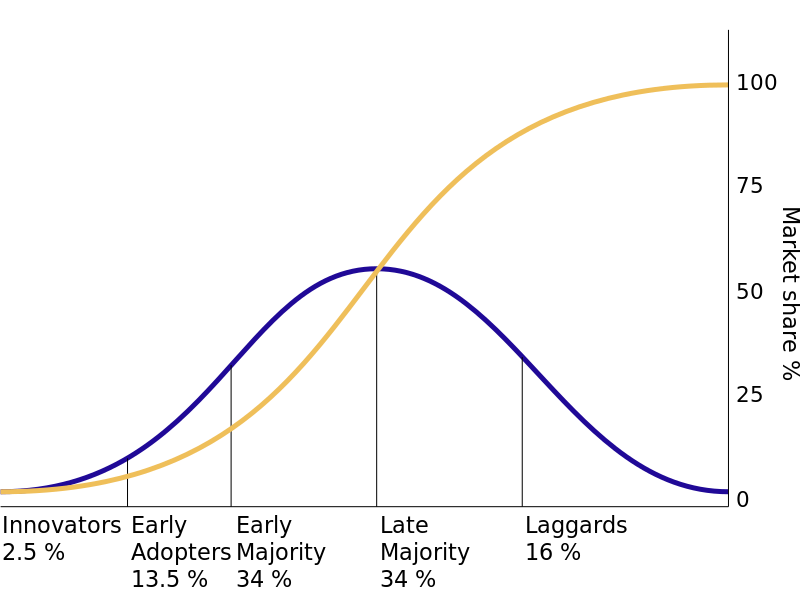
Innovators, Early Adopters and Early Majority
According to Rogers (2002), whereas innovators are cosmopolites, early adopters are localites. This adopter category, more than any other, has the highest degree of opinion leadership in most systems. Potential adopters look to early adopters for advice and information about an innovation.
Early majority are pragmatists, comfortable with moderately progressive ideas, but won’t act without solid proof of benefits. They are followers who are influenced by mainstream fashions and wary of fads. Majorities are cost sensitive and risk averse. They are looking for simple, proven, better ways of doing what they already do. They require guaranteed off-the-shelf performance, minimum disruption, minimum commitment of time, minimum learning, and either cost neutrality or rapid payback periods. And they hate complexity.
Robinson has summarised Rogers's ideas in of the Diffusion of Innovations and he suggests that when working with early adopters one should
- Offer strong face-to-face support for a limited number of early adopters to trial the new idea.
- Study the trials carefully to discover how to make the idea more convenient, low cost and marketable.
- Reward their egos e.g. with media coverage.
- Promote them as fashion leaders (beginning with the cultish end of the media market).
- Recruit and train some as peer educators.
- Maintain relationships with regular feedback.
Leading in a Culture of Change
If you haven't yet read Michael Fullan's book "Leading in a Culture of Change", we warmly recommend it. Fullan has written expansively about educational change and how to manage it. Since "Change is a double edged sword... for better of worse, change arouses emotions", it hopefully helps in your LDC2 planning that you are ok with your and others emotions.
He has proposed (2001) that leaders would become more effective with their efforts to lead in a culture of change if they would be constant in their efforts to establish these five components of leadership:
- Moral Purpose: A commitment to betterment and improving life
- Understanding Change: A culture of change consists of great rapidity and non-linearity on the one hand and equally great potential for creative breakthroughs on the other. The paradox is that transformation would not be possible without accompanying messiness.
- Relationships, Relationships and Relationships: How people interact with each other and the trust and loyalty they are able to create is essential to the success or failure of a change.
- Knowledge Building: The process of a person taking information in and creating an understanding that is then used in society.
- Coherence Building: Accepting that change is inevitable and can be positive, this is helping everyone make sense of the ’messiness’ that comes along with the changes that are being experienced.
Lean leadership plan?
When planning for the leadership of a change iniative in your LEADERSHP 2 assessment, focus on 'lean' from the point of view of lean production processes rather than from the point of view of the lean canvas (the old DCL canvas is in the portal). Lean canvas might help you to summarise your thoughts. It might help you to explain your innovation in short. But a lean canvas is not a lean leadership plan!
From a leadership perspective, focus on planning how you’ll lead the early adopters and subsequent followers. And design the leadership of an initiative that possibly consciously eliminates ‘muda’ (waste).
References and possible resources
Fullan, M. (2001). Leading in a Culture of Change. Wiley & Sons.
Harris, A., Jones, M. & and Baba, S. (2013). Distributed leadership and digital collaborative learning: A synergistic relationship? British Journal of Educational Technology 44(6), 926-939
Kilko, J. (2015). Design thinking comes of age: The approach, once used primarily in product design, is now infusing corporate culture. Harvard Business Review, 93(9), 66.
Nichols, J. (2010). Teachers as Servant Leaders. Rowman & Littlefield.
Papa, R., Mullen, C. & Creighton, T. (2012). Educational Leadership at 2050: Conjectures, Challenges, and Promises. R&L Education.
Plattner, H., Meinel, C., & Leifer, L. (Eds.). (2010). Design thinking: Understand–improve–apply. Springer Science & Business Media.
Robinson, L. (2009). A summary of Diffusion of Innovations. Retrieved from http://www.enablingchange.com.au/Summary_Diffusion...
Robinson, V. (2011). Student-Centered Leadership. Wiley.
Rogers, E. (2002). Diffusion of preventive innovations. Addictive Behaviors,27(6), 989-993.
Schleicher, A. (2012). Preparing Teachers and Developing School Leaders for the 21st Century: Lessons from around the World. OECD Publishing.
Whitaker, T. (2013). Leading School Change: 9 Strategies To Bring Everybody On Board. Taylor and Francis.

No comments:
Post a Comment