
This week we'll work around two ideas, Connected Learning and Connectivism that are trying to grasp those issues.
Connected learning seeks to find ways to connect the lives and experiences of learners to the outcomes that educators feel are necessary to prepare students for their futures. While no single recipe exists for connecting learning, it does require teachers to have strong relationships with their students and for them to understand their interests, motivations and what they care about. Armed with this information teachers are able to better connect their own agenda to the lives of their students in a manner that is relevant and engaging to the learner.
Connectivism There are several principles of the theory of connectivism, as outlined by George Siemens in 2004, in his article “a learning theory for the digital age”. The theory says that learning and knowledge rest in diversity of opinions, and that learning is a process of connecting specialized nodes or information sources. The ability to see the connections between fields, ideas, and concepts is a core skill, and nurturing and maintaining these connections is needed to facilitate continual learning. Because information is constantly evolving, while there is a right answer now, it may be wrong tomorrow. The capacity to know more is therefore more critical than what is currently known, but currency (accurate, up-to-date knowledge) is the intent of all connectivist learning activities. Thus decision-making is itself a learning process relating to choosing what to learn and the meaning of incoming information. Finally, learning may reside in non-human appliances, embracing the knowledge inherent in digital networks.
Whakatauki
He aha te kai ō te rangatira? He Kōrero, he kōrero, he kōrero.
What is the food of the leader. It is knowledge. It is communication.
Practising Teacher Criteria
1. establish and maintain effective professional relationships focused on the learning and well-being of ākonga
Connected Learning and Connectivism
If “Connected learning is about much more than plugging youth into technology.” Then what is connected learning?
Due to the rapid change and technological advancement, the demands and opportunities placed on our students are greater than ever. Constantly changing networks (personal, social, and work) challenge students to process, learn, and respond to torrents of new information and new technologies. Learning is no longer framed by restrictions of time and place. Knowledge is now available everywhere, 24 hours a day so new models of education need to recognise learning as a constant with delivery modes and learning times as the variables.
New education models are needed to expand learning beyond the school through connected networks that bring education opportunities together into a seamless, integrated experience. In 2016 there is no reason why the abundance of resources and knowledge on the internet should be contained within a physical classroom, and there is little reason why a student should be confined to only taking courses offered by their school.
The notion of ensuring interchange and integration of learning networks and of the resources should underpin the construction of new education models. Connected learning and connectivism are two complementary views of the power of the network in 21st century learning
In Class Activities
While doing the in-class collaborative task 'How could the learning of your students be more social, participatory, interest-driven and relevant to the opportunities of our time' use the following links.
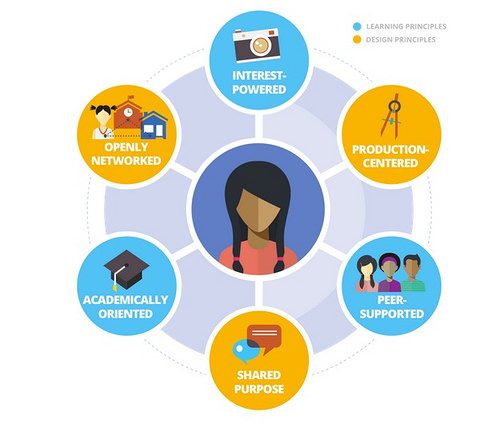
Six Principles of Connected Learning - hover your cursor over the picture on the web site (matching the one below) for interactive pop up descriptors.
Checklist To Implement Connected Learning Principles - suggestions on ways to implement the spheres of learning and a checklist of core properties of program design.

No comments:
Post a Comment